

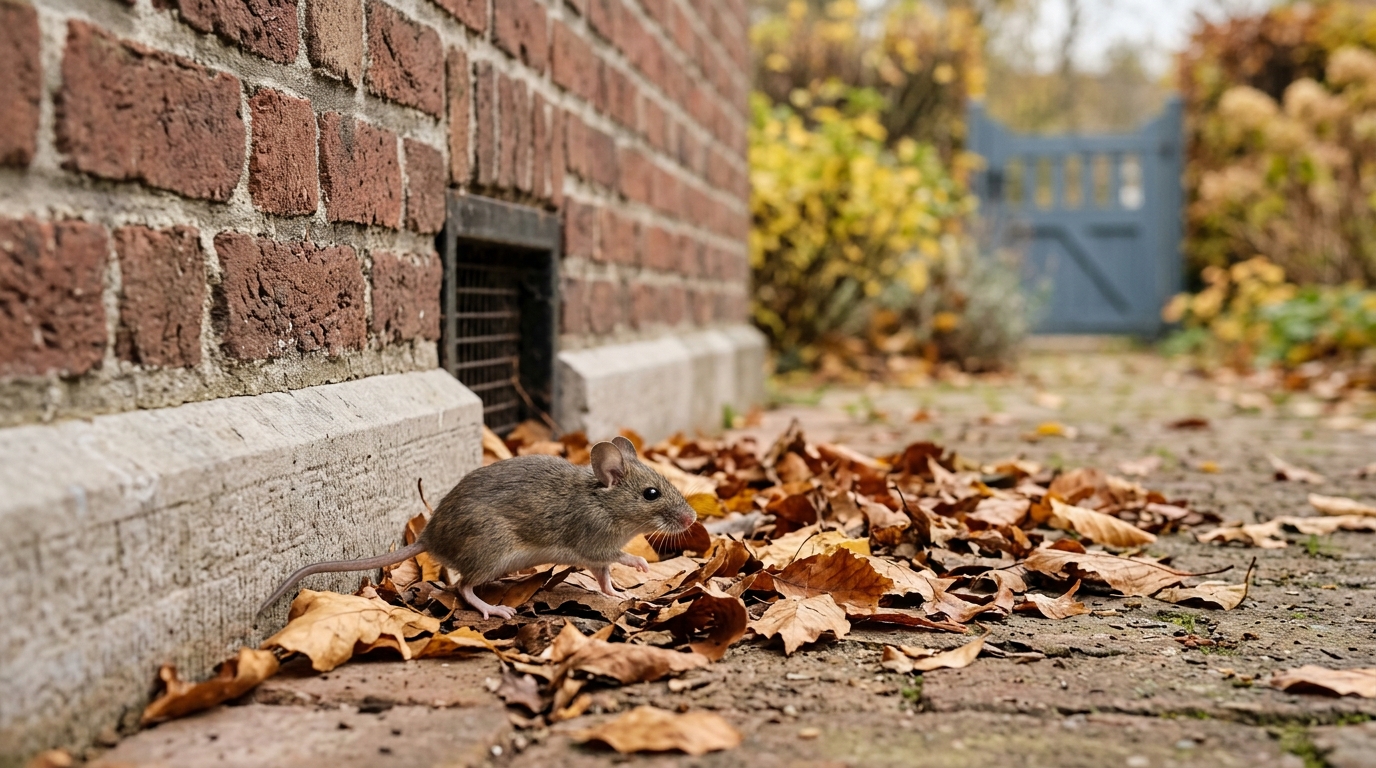
Every year, it follows the same pattern. Temperatures drop, the nights grow longer, and suddenly suspicious noises can be heard inside the walls or under the kitchen sink. In autumn, mice leave gardens and outdoor spaces to seek warmth and food inside homes. This affects both houses with gardens and flats, in Brussels as much as throughout the Brabant Wallon and Flemish Brabant areas. Understanding why they come in, recognising the signs of their presence and knowing what to do are the three essential steps to take.
Why Autumn Is the Critical Season for Mice
The common house mouse, or Mus musculus, is an opportunistic and highly adaptable creature. In summer, it finds food and shelter outdoors with little difficulty. But as soon as temperatures fall, it seeks a warm refuge with reliable access to food. Your home ticks every one of those boxes.
Several factors specific to autumn encourage this migration indoors:
- Falling outdoor temperatures make natural shelters – woodpiles, compost heaps, dense vegetation – far less comfortable and protective.
- The end of the kitchen garden season reduces food sources outside.
- Fallen leaves accumulating against walls or cellar vents create discreet corridors that make it easier for mice to access buildings.
- Groundwork or tree surgery carried out nearby can disturb entire colonies and force them to move on.
In densely built-up areas such as Brussels, old sewer networks, interconnected cellars between buildings and the many voids between walls and floors give mice invisible motorways along which they can travel from one building to the next.
Where Exactly Do They Get In?
This is often the question that surprises people most: a mouse can squeeze through a gap no bigger than a coin. It does not need a wide-open door to let itself in. The most common entry points are:
- Cracks in foundations or exterior walls, even very small ones.
- Cellar vents without a mesh cover, or with a mesh that is too coarse.
- Gaps around pipes and cables passing through walls, which are frequently left poorly sealed.
- The space under exterior doors, particularly those of garages or outbuildings.
- Worn weatherstripping around cellar windows or service doors.
- Ventilation and extraction ducts when they are not protected by a suitable grille.
In houses with gardens, woodpiles stacked against the facade or unsecured compost bins also serve as indirect entry points: they act as a first staging post before the animal seeks a way into the building itself.
The Tell-Tale Signs
A mouse infestation is often discreet in the early stages. Mice are nocturnal and cautious. Even so, several clues give them away:
- Droppings: small, dark, elongated pellets, often found under the sink, behind kitchen appliances or inside cupboards.
- Night-time noises: scratching, scurrying or squeaking sounds inside walls, the ceiling or beneath the floor.
- Gnaw marks: on bags of flour, cereal packets, electrical cables or even insulation materials such as polystyrene.
- A distinctive smell: musty and persistent, particularly in confined spaces such as a cellar or a crawl space.
- Nests: made from paper, fabric, insulation or any other soft material, usually tucked into dark corners.
If you notice one or more of these signs, acting quickly is essential. A female mouse can give birth several times a year, and a colony can grow very rapidly if it is not brought under control at the first warning signs.
What You Can Do Yourself to Prevent an Infestation
Prevention is your best ally. Even before a mouse crosses your threshold, a few straightforward measures can considerably reduce the risk of an infestation.
Securing Entry Points
- Inspect the perimeter of your home for cracks and seal them with mortar, mastic or steel wool (which mice cannot gnaw through).
- Fit fine-mesh grilles over cellar vents and ventilation openings.
- Check the draught excluders under exterior doors and replace them if necessary.
- Seal pipe and cable entry points with a suitable product.
Removing Attractions
- Store foodstuffs in airtight glass or metal containers.
- Do not leave pet food out overnight.
- Keep woodpiles and compost bins away from the walls of the house.
- Avoid storing cardboard or paper in rarely visited areas: they make ideal nesting material.
- Keep the cellar and garage tidy and clear to reduce potential hiding places.
Garden and Surroundings
- Cut back vegetation growing against the walls and make sure that dense shrubs close to the building cannot serve as a refuge.
- Regularly clear fallen leaves that have built up against the foundations.
- If you keep chickens or other poultry, store their feed in sealed containers.
When Should You Call a Professional?
Shop-bought traps and over-the-counter repellents can sometimes be enough to deal with a single stray mouse. But in most genuine infestation situations, these solutions do not address the problem at its root. They may eliminate a few individuals without tackling the colony itself or the entry points.
It is time to call in a professional in the following situations:
- You are finding signs of activity in several rooms or on multiple floors of the building.
- Traps that have been set yield no results after a few days.
- You continue to hear noises at night despite your initial efforts.
- Electrical cables or pipes have been gnawed, which poses a real risk of fire or water damage.
- You live in a flat or a jointly owned building: in this case, the problem may originate in the communal areas or shared walls, and a coordinated response is required.
A specialist technician will begin with a thorough inspection to locate the access routes, assess the extent of the infestation and identify the entry points. They will then put in place an appropriate treatment and long-term preventive measures, including sealing the identified access points.
To find out more about professional intervention methods, read our article on rodent elimination in Brussels in two steps. And if you are unsure whether the animal you spotted is a mouse or a rat, our article mice and rats: what is the difference? will help you tell them apart – an important distinction, since behaviour and solutions differ significantly between the two.
Act Early, Act Less
Autumn is the period when early action makes all the difference. A single mouse can become a colony within a matter of weeks. Taking the necessary precautions at the first cold snap, inspecting your property’s access points and reacting to the slightest suspicious sign will save you a great deal of trouble further down the line.
If you have any doubt whatsoever, Nuisibles-Out is available 7 days a week in Brussels, Brabant Wallon and Flemish Brabant. A quick inspection is always preferable to an established infestation. Contact us via the mouse pest control page for an initial assessment.