

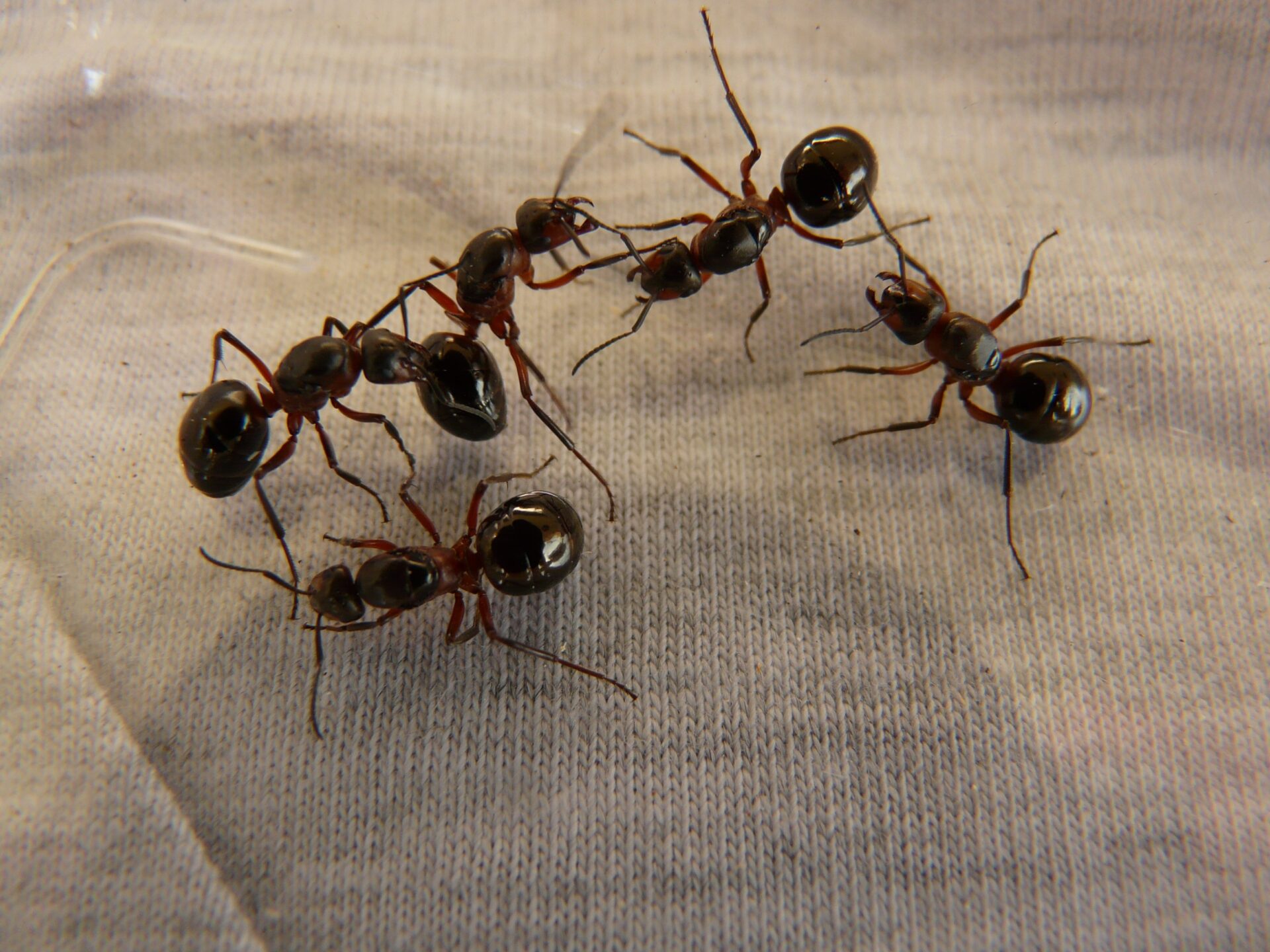
A column of ants crossing your kitchen, insects trailing along the skirting boards or emerging from a grouting joint: this scenario is far from unusual in Brussels flats. Whether you are a tenant, an owner or a managing agent for a block of flats, an ant invasion can quickly become a serious headache if it is not tackled at source.
The Most Common Species Found in Brussels Homes
Before taking action, it is essential to identify the species involved. In Brussels, Walloon Brabant and Flemish Brabant, several species are encountered regularly, but two of them are by far the most prevalent.
The Black Garden Ant (Lasius niger)
Lasius niger is the most widespread species in urban environments. Dark brown to black in colour, it measures between 2 and 5 mm. Its colonies can number several thousand individuals and are characterised by what is known as polydomic behaviour: a single colony may occupy several nests dispersed throughout a building, which makes elimination particularly complex. It readily nests in foundation cracks, under concrete slabs, between walls or inside window frames. In summer, swarming events (flights of winged ants) can cause genuine alarm among residents. The detailed fact sheet on Lasius niger at myrmecofourmis.org confirms its remarkable adaptation to built environments.
The Pharaoh Ant (Monomorium pharaonis)
Monomorium pharaonis is a tropical species that has adapted perfectly to heated buildings. Very small (1.5 to 2 mm) and yellow-orange in colour, it is particularly difficult to detect. It favours warm, humid spaces: behind radiators, inside service ducts, false ceilings or bathroom joints. Its colonies are polygyne (several queens per nest) and can split into sub-colonies the moment they feel threatened, which means amateur treatment is not only ineffective but often counterproductive.
Other Species Not to Overlook
While Lasius niger and the pharaoh ant are the most frequently encountered indoors, other species can occasionally make their way into homes:
- The Argentine Ant (Linepithema humile): originating from South America, it forms highly aggressive super-colonies and can rapidly colonise an entire building. Its light brown colour and small size (2 to 3 mm) make it difficult to distinguish with the naked eye.
- The Carpenter Ant (Camponotus ligniperdus): larger (up to 15 mm), it excavates its galleries in damp or deteriorating wood. Its presence in a flat may indicate a moisture or structural problem worth investigating.
- The Red Wood Ant (Formica rufa): rarely found inside flats, it can nonetheless enter dwellings situated on the edge of green spaces or parks, as are common on the outskirts of Brussels.
- The Yellow Meadow Ant (Lasius flavus): a subterranean species that nests under paving slabs and in lawns, it sometimes bursts into ground-floor flats and cellars during seasonal swarming.
Correctly identifying the species is a key step: each ant responds differently to treatments, and a misidentification can lead to ineffective or even counterproductive interventions.
Why Ants Settle in Flats
A flat offers ants everything they need: warmth, moisture and accessible food. The following factors encourage them to move in:
- Crumbs and food residues left uncleaned, particularly in kitchens
- Cracked grouting or detached skirting boards, which create entry points
- Pipes and service ducts, which act as motorways between floors
- Poorly maintained cellars and crawl spaces in older buildings
- Vegetation in direct contact with the facade (window boxes, ivy, shrubs)
In a block of flats, the problem takes on an additional dimension: if one flat is treated without addressing the common areas, the colony simply moves next door.
Why DIY Treatment Almost Always Fails
Over-the-counter products (sprays, powders, gels) give the impression of doing something. In reality, they eliminate the visible worker ants but leave the queen and the secondary nests untouched. Worse still: with the pharaoh ant, a poorly targeted repellent treatment triggers what is known as colony budding. Sensing danger, the queen dispatches sub-groups to establish new nests in other parts of the building. The result is that a localised infestation becomes a diffuse one, far harder to eradicate.
The same risk exists with Lasius niger in a polydomic building: killing the visible ants in one flat simply shifts the problem to neighbouring floors or the common areas.
What Residents and Managing Agents Can Do
For Residents
Before a professional intervenes, a few sensible measures will reduce the attractiveness of your flat:
- Clean worktops regularly and store food in airtight containers
- Repair failing joints and seal any visible cracks around pipes
- Notify the managing agent promptly if you spot ants and live in a block of flats
- Avoid using repellent sprays if you suspect pharaoh ants: this will make the situation worse
For Managing Agents and Blocks of Flats
In a building, a coordinated response is essential. Treating individual flats in isolation is a waste of time and money. The managing agent would do well to commission a specialist firm to carry out a full inspection of the building, including common areas, cellars, plant rooms and service ducts. A joint action plan, agreed with the co-owners, is the only approach that guarantees lasting elimination.
Older Brussels buildings, which are numerous in boroughs such as Ixelles, Saint-Gilles, Etterbeek and Molenbeek, are particularly vulnerable owing to their complex structure and the many cavities they contain.
Professional Treatment: How Does It Work?
At Nuisibles-Out, every intervention begins with a thorough inspection to identify the species, locate the primary and secondary nests, and map the routes used by the ants. The treatment is then tailored to the species:
- For Lasius niger: targeted application of gels or contact insecticides on the movement routes and nest entrances, with sealing of access points where necessary
- For Monomorium pharaonis: exclusive use of non-repellent bait gels, which allow worker ants to carry the product back to the queen and eliminate the colony at source
We operate 7 days a week in Brussels, Walloon Brabant and Flemish Brabant, with a discreet approach that fits around your daily life. For blocks of flats, we can draw up a comprehensive treatment plan and provide ongoing monitoring.
Would you like to find out more about our methods and the pests we treat? Visit our dedicated page on ant disinfestation in Brussels or discover how we handle the most common pests in Brussels. If you are still weighing up whether to treat the problem yourself or call in a professional, our article on DIY versus professionals will give you a clear perspective.
Do Not Let the Situation Get Worse
An untreated ant invasion does not go away on its own. Colonies grow, split and colonise new spaces as the seasons change. The longer you wait, the more complex and costly the intervention becomes. The right decision is to act quickly, with the right tools and the right expertise.
Contact Nuisibles-Out now for a prompt inspection and a solution tailored to your situation, whether you are a private resident or a managing agent for a block of flats.